For me, cEDH can be a little brain power-intensive.
I have the memory of an ant on the best of days, and most games happen after a full day of mathing at work. By that point, my ability to focus is practically nonexistent.
Recognizing this about myself (see, I do possess some self-awareness) led me to my next great mistake.
I mean, I obviously build great decks, so surely it couldn’t possibly be my piloting skills that were the problem.
Right?
Enter Slicer, Hired Muscle
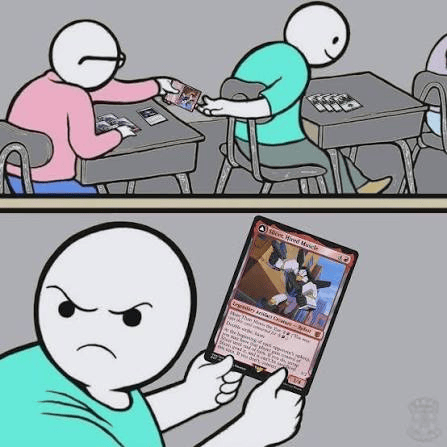
I was first introduced to Slicer, Hired Muscle when a member of our MTG group brought it to a Taco Bell game.
After Born2Game closed at 10 PM, a group of us would head to Taco Bell to hang out, play or watch a game of cEDH before heading home for the night. Yes, we are those nerds.
Honestly, this is where I learned the most about the format and discovered a lot of the high-powered cards.
The Taco Bell crew was incredibly patient with my questions and never made me feel stupid, despite most of them being pretty basic.
For example:
Me: “Counterspell is such a great spell. Why aren’t you playing that?”
The answer: Counterspell costs two blue mana. You need to have access to two blue mana when you want to interrupt someone else’s attempt to win. In cEDH, holding up that mana isn’t always as easy as it sounds.
Me: “I thought we were supposed to have 33–36 lands. Why do you have so few?”
The answer: cEDH is a faster format that relies heavily on cheap and free mana sources. Instead of filling the deck with lands, players use acceleration and efficient spells to get their game plans online quickly.
Two Birds, One Card
The player running Slicer would pass the card around the table, forcing everyone else to hit each other while sitting back and watching the chaos unfold.
I admired that ability tremendously.
Here was a commander that encouraged everyone to fight among themselves while I sat back and watched. Nobody could be upset with me for repeatedly hitting them with commander damage because, technically, I wasn’t the one doing it.
Two birds, one card.
Perfect.
I could play a simpler deck, avoid complicated lines, and let everyone else do the heavy lifting.
What could possibly go wrong?
I Choose Violence
When I started building I Choose Violence, I followed the same process I’d used for Day-Oh and Thalia.
I went to EDHREC.com and used the search function to pull a list of commonly played cards in a Bracket 5 Slicer deck.
This time, I removed my previous budget restrictions. See? I learned something.
I was perfectly comfortable using proxies, so cost was no longer a limiting factor. That also gave me room to experiment with cards I came across that I thought, in all my infinite wisdom, might work.
While I wanted the deck to be simple, I also wanted it to kick ass.
I kept the same basic requirement, though: I needed to understand what a card did and, at least in theory, how it worked.
Sort of.
The entire goal of this deck was to get Slicer onto the battlefield, make the table fight each other, and sit back while everyone else did the dirty work.
To support this brilliant plan, I included red and colorless stax pieces like Blood Moon, Winter Orb, Static Orb, and Damping Sphere.
I also included this super-expensive land called The Tabernacle at Pendrell Vale.
Which, by itself, is great. It triggers for each creature during its controller’s upkeep, requiring them to pay one mana for that creature or sacrifice it.
My deck only ran 13 creatures. I had this in the bag!
Yes, I know.
I was stupidly evil in my attempts to control everyone where it hurt the most: their mana.
I thought I was brilliant.

I was something, but brilliant definitely wasn’t it.
On paper, the deck looked perfect. In practice, it just required everyone else to cooperate, Slicer to survive, and me to remember what was happening.
No Biggie.
Slicer, No Slicing
The first problem was that I relied heavily on Slicer to kill everyone through commander damage.
What my brilliant game plan failed to account for was that the other players in the pod would try to kill Slicer as quickly as possible.
Apparently, my opponents weren’t interested in politely cooperating with my plan.
Rude.
The second problem was that I didn’t understand how commander tax worked when recasting Slicer.
I thought that because Slicer’s mana value was three, commander tax wouldn’t apply when I cast him again from the command zone.
Judge!
It does apply.
And here’s the embarrassing part: I played multiple games without paying commander tax.
I wasn’t trying to cheat. I genuinely thought I was playing the card correctly.
Unfortunately, the rules don’t care about my intentions. I was casting Slicer incorrectly, and my opponents were playing against a version of the deck that wasn’t following the actual rules.
In my defense, I didn’t know what I didn’t know.
Which, at this point in my cEDH journey, was apparently quite a lot.
Okay, let’s be honest. There’s still a crap ton I don’t know, but I’m working on it slowly but surely-ish.
My Backup Plan Was Also a Problem
My backup win condition was Godo, Bandit Warlord and Helm of the Host.
The plan was there. The problem was getting it online.
Godo costs six mana, and fortunately, his enters-the-battlefield ability lets me search for Helm of the Host and put it directly onto the battlefield.
Small victories!
Unfortunately, getting Helm onto the battlefield was only half the battle. I still needed to pay its five-mana equip cost and keep Godo alive long enough to attack.
That meant I needed eleven mana to cast Godo and equip Helm, assuming nothing reduced those costs.
I had adequate mana sources, but much of that mana was colorless or came with conditions that needed to be met before it was useful.
And while mono-red has ways to interact with opponents, I hadn’t given myself enough tools to stop them from going off or protect myself once I became the target.
Which, when you’re playing a commander that encourages everyone to attack and deal commander damage, happened a lot.
Combine that with stax pieces that were also making life difficult for me, and we arrive at a familiar conclusion.
I did it again.
I’d built a deck intended to simplify my life, then filled it with cards that restricted what everyone could do, including me.
Again, I learned nothing.
Go figure.
The Attention Span Has Left the Building
Eventually, I got bored.
And when I get bored, my attention span packs its bags and leaves to get milk.
Suddenly, I was distracted, missing triggers, and frustrating the table all over again.
One of these days, missing triggers will be a thing of the past.
One.
Of.
These.
Days.
Until then, I needed to find a deck that was sans red and played Golgari and blue.
Because all the best players play blue, so obviously, I needed to play blue too.
Right?
What in the Hell was I thinking?


Leave a Reply